
Recently, I had the opportunity to watch the movie “Oppenheimer” at the Caribbean Cinemas in St. Croix. As someone fascinated by the legacy of the man known as “The Father of the Atomic Bomb,” J. Robert Oppenheimer, I couldn’t help but be curious about his life. During my visits to St. John, I learned that he spent his final days in seclusion at Hawksnest Bay, where his modest home still stands, now fondly known as Oppenheimer Beach. This sparked my interest in whether Oppenheimer ever visited St. Croix.

The movie “Oppenheimer,” based on the book “American Prometheus: The Triumph and Tragedy of J. Robert Oppenheimer,” skillfully portrays the events leading up to Oppenheimer’s role in the Manhattan Project. It delves into his complex interpersonal relationships with figures like Lewis Straus and Lt. General Leslie Groves, among others, who were instrumental in the success of the project.
The film sheds light on the assembly of brilliant minds in theoretical physics and quantum mechanics, who worked together in the remote town of Los Alamos, New Mexico, to create the atomic bomb during World War II. Ultimately, it focuses on J. Robert Oppenheimer’s pivotal role in making the Manhattan Project a triumph.

Surprisingly, the atomic bomb itself is only part of the narrative in “Oppenheimer.” The main plot revolves around the efforts to renew Oppenheimer’s security clearance, a decade after World War II’s end. This particular aspect of the movie intrigued me and led me to contemplate the events that prompted Oppenheimer to relocate his family to the secluded bay on St. John in the US Virgin Islands.
While the movie doesn’t mention St. John or the Virgin Islands explicitly, it does provide insight into why he sought refuge there—escaping the scrutiny of the CIA and FBI, who questioned his loyalty to the US and ultimately revoked his security clearance due to Lewis Straus’ behind-the-scenes political maneuvers. Given this situation, it is entirely understandable why he chose to protect his family and spend his final days away from the public eye.

“Oppenheimer” offers a captivating exploration of history and human complexities, making us reflect on the choices and circumstances that shape the lives of remarkable individuals like J. Robert Oppenheimer.
Now back to my original question, Did Oppenheimer ever visit St. Croix?
Still, my curiosity persisted, and I found myself pondering whether there were any noteworthy visits to St. Croix. After all, it was just a short sailing trip away from St. John. I came across an intriguing story about Oppenheimer’s life on St. John through our sister readership, NewsofStJohn.com, which I highly recommend reading.
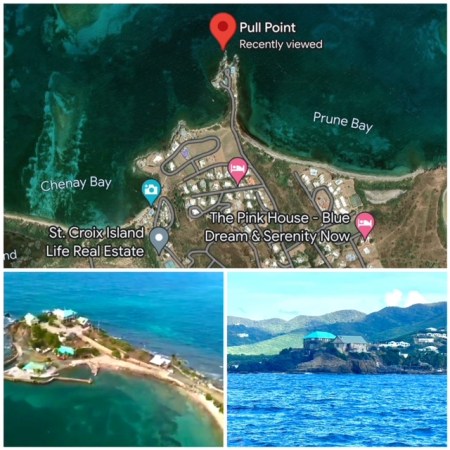
Returning to my original question, I discovered that Oppenheimer did indeed visit St. Croix. There are firsthand accounts of him having a guest house on the island before eventually settling on St. John. Further research revealed that he was friends with the Dale family, who owned property on Pull Point, situated between Chenay Bay and Prune Bay. In the early 1950s, Ted Dale constructed a modest home on Pull Point for the Oppenheimer’s to use.


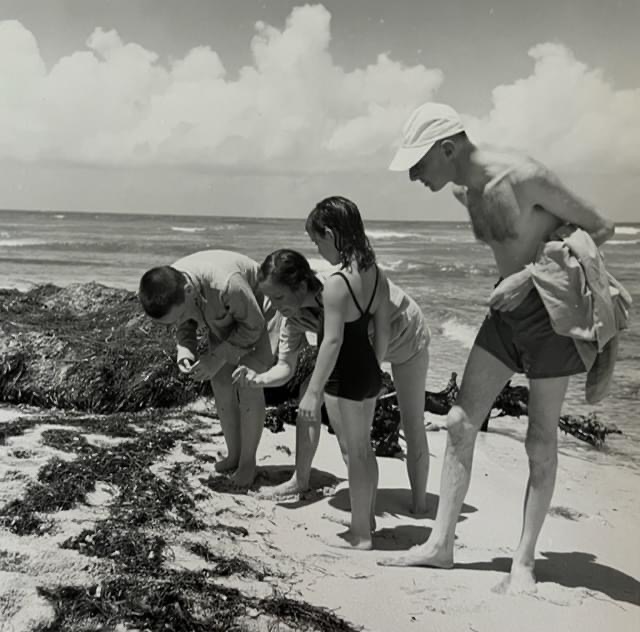
Photo Credit: Fritz Henle
The above pictures depict the Oppenheimer family enjoying some beach time at Pull Point, beautifully captured by Fritz Henle, a renowned photographer who made St. Croix his home in 1958. The Henle Fine Art Gallery showcases his family’s extensive studio and gallery works, where you can also find studios belonging to his daughters, Maria Henle and Tina Henle. The legacy of talent runs in the family, and I extend my special thanks to Tina for providing the background on the Oppenheimer family photos, which add a fascinating layer to St. Croix’s history.

The movie about Oppenheimer’s life was truly impressive and deserving of all the accolades it has received. It will likely receive nominations for Best Picture awards as well. For me, it was not only entertaining but also intriguing to witness the series of events that led one of the world’s greatest scientific minds to retreat to a secluded bay on a desolate beach, where he lived with his family in a modest home and pursued poetry.
The weight of creating a weapon that would forever alter the course of world history is not lost on me. The profound quote from the Bhagavad- Gita (The Lord’s Song), “Now I am become Death, the destroyer of worlds,” reiterated by Oppenheimer during the first successful Atomic Bomb test, carries immense significance. Considering the totality of Oppenheimer’s mindset during those times, it seems fitting that he would choose to find solace on a remote beach on a tiny island in the middle of the Caribbean.


My husband and I are living in the Fritz Henle home which we bought from Tina two years ago. It’s a real honor to live in this little gem up on Little Princesse Hill. The connections Fritz made throughout his life are astounding. I would love to know how he and Oppenheimer met and gain insight into their relationship!
Very cool, thanks for commenting. I couldn’t speak to the Oppenheimer and Henle relationship or meeting, but Tina suggested connecting with some of the Dale family who still live on the island. And yes, it seems Fritz Henle lived a “Forest Gump” type of life capturing amazing worldy moments with his photography. I thought it was a cool tidbit of St Croix history that Oppenheimer spent time on St Croix also.
Probably through Ted since Ted and Fritz arrived on St Croix on the same day in 1947. Not together though. They became good friends. The iconic photo of the Christiansted harbor and wharf was taken by Fritz from the top of the mast of Ted’s yawl, the Comanche.
I met the Oppenheimers at the Comanche hotel when I was 15. Peter and I became friends then. Basically there was no one else around about my age to associate with. We had fun. Robert was a cool guy who really connected with his kids.
We spent vacations at Pull Point with the fabulous Dales and met the Oppenheimers. My father was a Naval pilot in the South Pacific and met Ted, who built and owned The Comanche, in the Navy. I would love to have heard their conversations about meeting the man who had such an impact on their lives and what happened to him.
Thanks for commenting Amy, I, too, would have loved to be a fly on the wall for those conversations.
And I remember your parents. 🙂
In the early 1980s, I remember a postcard depicting scantily clad girls on Oppenheimer’s rusting hulk of a car at Ted Dale’s place at Pull Point.
The text on the postcard read something like: “Even if I do get it started, I’m not coming home.”
That’s a Toby Schoyer postcard. Never knew it was Oppenheimer ‘s car though.